
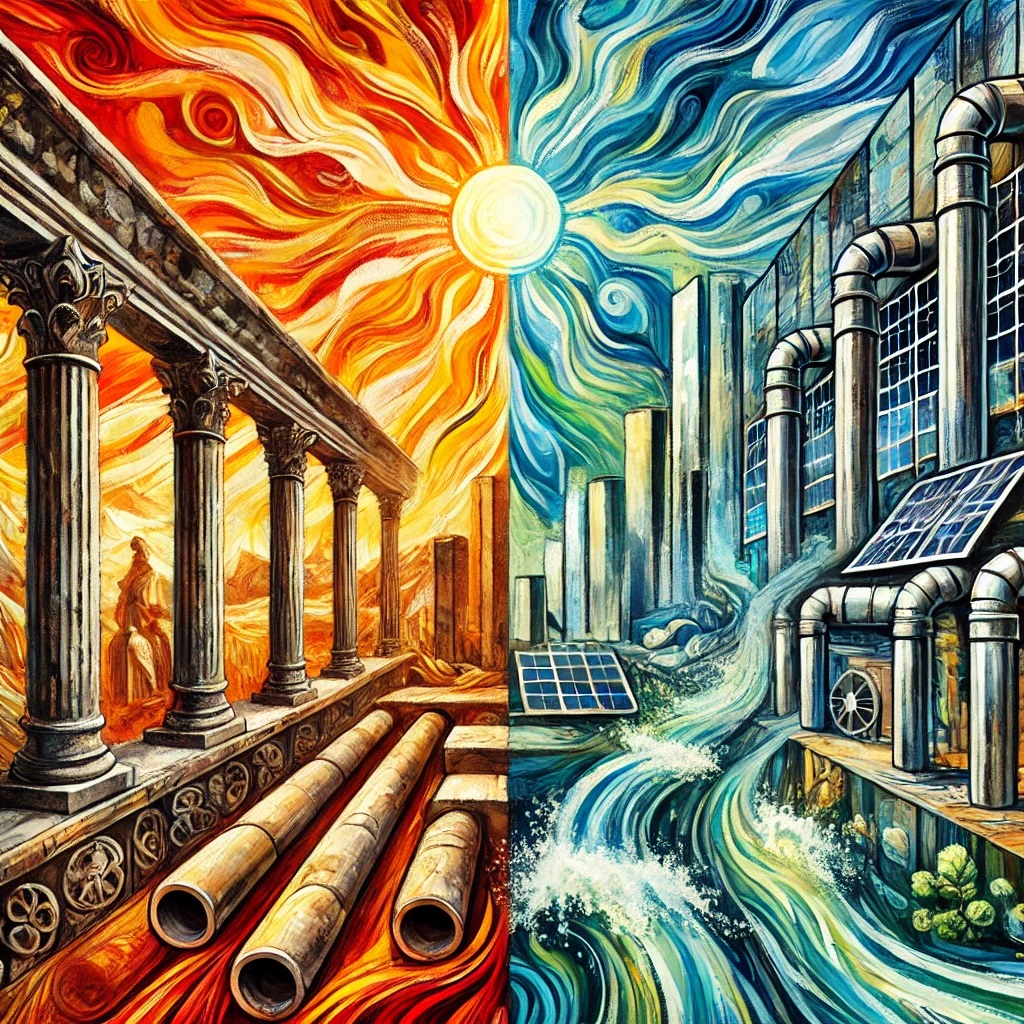
The past two hundred years of human history have shown the world an exponential economic expansion (say that one three times fast). Before the industrial revolution and its destruction of the environment, there were entire civilizations running on comparably sustainable technology that we have since deemed ‘obsolete’. The world is much different today considering that everything functions on a much larger scale. However, some technology of the past can certainly be learned from and revisited. Here are a few brief examples:

Hypocausts
A hypocaust is a heating system invented in ancient Rome. They were most notably employed in public bathhouses which required large amounts of hot water, but also found use in both public buildings and private homes. Here’s how they work:
Hypocausts consist of hot air ducts branching outward from a centralized basement furnace. These ducts carry air and smoke into enclosed areas between the floors and walls of a building, providing centralized heat. Think of a woodstove in a modern house, only built to distribute the heat evenly around the entire property (including to its water). The downside, of course, is the danger of burning wood in an enclosed space. where you have to worry about structure fires or carbon monoxide poisoning.
Now, you may be thinking: is a glorified woodstove really credited for heating an entire civilization on its own? That must’ve required a lot of wood- and while that is better than what the world relies on currently, even the Romans were cautious of their overuse of wood and subsequent deforestation. This is where solar power comes in.

Solar Heat
Along with the prominent use of hypocausts, the ancient Romans also had an impressive plumbing system of pipes and aqueducts. With this system came a heating technique that preceded the invention of electricity and the use of fossil fuels: the sun.
Romans, unaware of the toxic properties of lead, used lead pipes for their water. The dark color of the metal and large potential for heat conductivity was perfect for their vision: hot water in every home. Bathhouses and homes utilized solar heated water along with their hypocausts, so they’d burn less wood and produce less carbon monoxide. With these two methods in tandem, the Romans had a consistent heating system that, while dangerous and underdeveloped, could be considered extremely sustainable compared to the methods of today.
Potential Improvements
Even though they are good for the environment, ancient Roman technology ideas would need a full revamp to be useful in contemporary times. Here are a few places to start:
- Dark colored non-toxic metal pipes that are placed above ground would function the same way that Roman lead pipes did. The dark color would absorb solar heat naturally. This is much more primitive and inefficient than using solar panels, but is a cost-effective idea if your goal is to live off the grid.
- With proper safety precautions, woodstoves are a viable heating option in smaller homes today. Architectual techniques in new house construction can maximize the flow of heat from room to room in the same way that hypocausts do, without allowing smoke in the house. Open floor plans are ideal for these stove-heated homes.

Final Thoughts
Many American people and politicians feel that sustainability is just not doable in this day and age, especially with such a large population to cater for. However, Rome was a highly populated and extremely successful empire for hundreds of years. Roman society was similar to America in many ways.
They were sustainable because they existed long before sustainability was even a choice. Today, as Americans, we can become sustainable by choice.
References
Price, M. (2017, August 28). Origins of ancient Rome’s famed pipe plumbing system revealed in soil samples. Www.science.org. https://www.science.org/content/article/origins-ancient-rome-s-famed-pipe-plumbing-system-revealed-soil-samples








Leave a Reply