
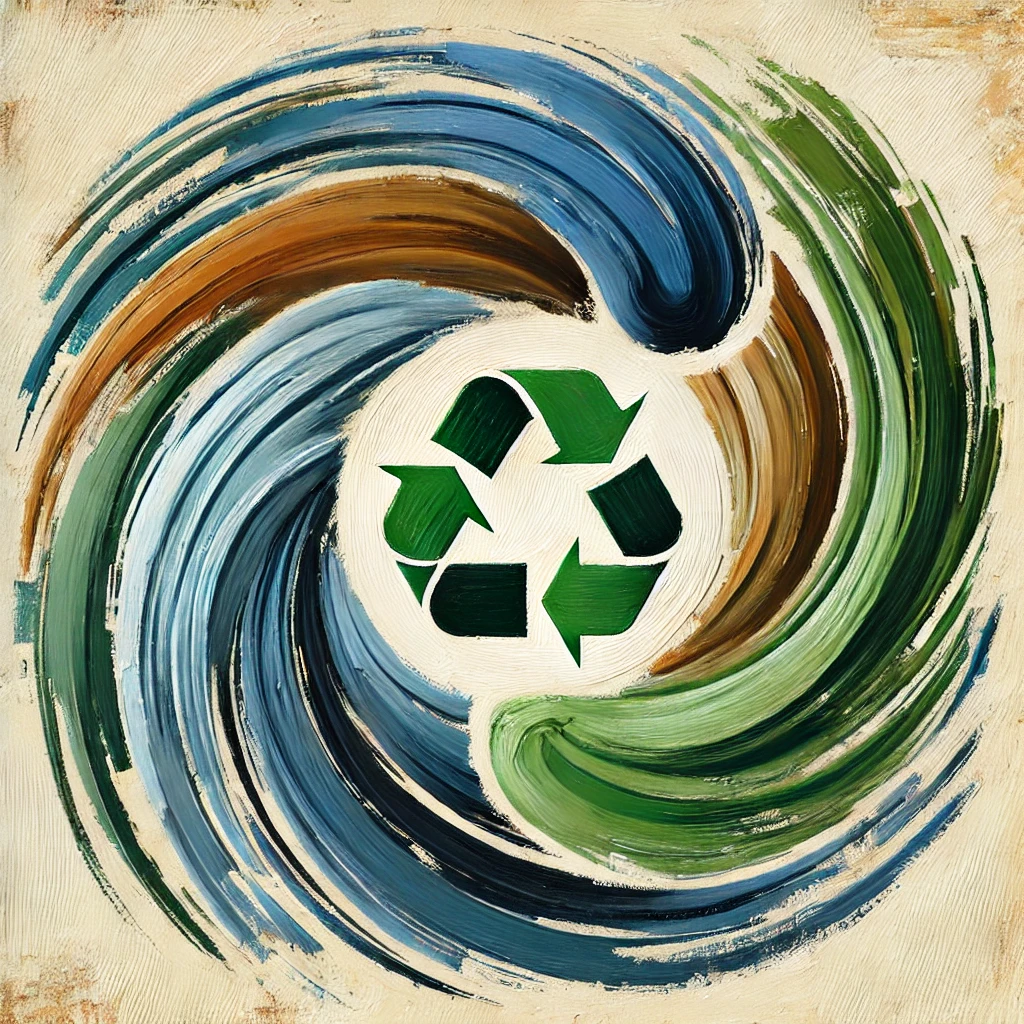
The world consumes and throws away recklessly. Resources are plundered, goods are made, and waste piles higher. This can’t last. The earth feels it. So do we. A circular economy offers another way. It takes waste out of the equation. It keeps resources moving, alive, and useful. Here’s what it is, why it matters, and how it might save us.
“We do not inherit the earth from our ancestors; we borrow it from our children.”
-Native American Proverb
What Is a Circular Economy?
A circular economy works like nature. Nothing wasted. Everything used again. It’s a system where products are built to last and materials don’t get tossed away after one go. The linear economy — dig, make, discard — belongs to the past. A circular economy just makes better sense.
Circular Economy Fundamentals

Design Out Waste and Pollution
Waste isn’t inevitable. It’s a flaw. Products need smarter designs, and materials need to come from places that heal, not harm.

Keep Products and Materials in Use
Repair the broken. Reuse the old. Recycle what you can. Nothing gets thrown away without a fight.

Regenerate Natural Systems
Give back to the land. Let the earth breathe. What we take, we must return, better and stronger.
The idea is old, as old as the people who lived by the seasons, who used every part of the buffalo and let nothing go to waste. Today, the wisdom of the past meets modern ingenuity. Think solar panels, biodegradable packaging, or a jacket made from the remnants of ten others.
The Common Sense, Every Day Benefits of a Circular Economy

A circular economy isn’t just an idea for businesses and governments; it offers tangible benefits to everyday consumers. For too long, the linear economy has forced us into a cycle of buying, using, and discarding. The circular model flips the script, giving consumers more value and freedom.
- Longer-Lasting Products
In a circular economy, products are designed to last. Appliances are easier to repair, clothing is made to endure, and technology can be upgraded instead of replaced. Imagine a phone with modular components that you can replace individually instead of discarding the whole device. - Cost Savings
Durable, reusable products reduce the need for frequent replacements, saving money in the long run. Rental and sharing models, like tool libraries or car-sharing programs, also reduce the financial burden of ownership. - Pride and Enthusiasm for the World Around Us
Consumers gain trust and pride in the businesses and governments that embrace this methodology. Today most consumers feel exploited and have no confidence in the lasting ability of the products we buy. It’s commonplace to assume the products are designed to break in a few days, weeks, months so we have to buy a replacement. What about replacement parts being almost as expensive as a complete replacement? Anyone not living under a rock in the last 20 years probably has experience with this. - Healthier Living Environments
By reducing pollution and waste, circular practices contribute to cleaner air, water, and living spaces. Consumers directly benefit from a healthier planet, free from the toxins of overproduction and inferior product design and disposal.
The Circular Economy Origin Story
The circular economy as we know it today owes its roots to several visionaries who sought to challenge the wasteful systems of the linear model.
- Walter R. Stahel
A Swiss architect and economist, Stahel introduced the concept of “product-life extension” in the 1970s. His ideas of reusing, repairing, and remanufacturing products laid the groundwork for what would later become the circular economy. - Kenneth E. Boulding
In his 1966 essay, “The Economics of the Coming Spaceship Earth,” Boulding emphasized the need for a closed-loop system, describing Earth as a “spaceship” with finite resources. - The Ellen MacArthur Foundation
Founded in 2010, this organization brought global attention to the circular economy through research, advocacy, and collaboration with businesses.
These pioneers turned a simple idea into a framework for transforming our economy. From theory to practice, they have shown us how we can design a world where waste is no longer part of the equation.
Why Does a Circular Economy Matter Work For Everyone in a Sustainable World?

The circular economy isn’t a dream. It’s a solution to a system gone astray. The linear economy thrives on planned obsolescence — products designed to fail or grow outdated, forcing consumers to buy anew. This wasteful cycle drives profits but empties the planet of its resources and fills it with garbage.
The world’s problems — vanishing resources, climate chaos, mountains of waste — demand action. A circular economy breaks this cycle. It replaces exploitation with regeneration, disposability with durability, and consumption with careful stewardship. This is action.
Addressing Resource Scarcity
By 2050, there will be nearly 10 billion of us. The planet isn’t growing, but the hunger for materials is. We need to do more with less. Companies like Patagonia show the way with initiatives like their Worn Wear Program and NetPlus. They make sturdy clothes from things you’ve thrown away. The old becomes new, and the cycle goes on.
Reducing Environmental Impact
Plastic clogs the oceans. Landfills tower ever higher. Smoke chokes the sky. But it doesn’t have to. A circular economy could slash carbon emissions nearly in half by 2050 (Ellen MacArthur Foundation, n.d.). Companies like IKEA prove it can work, taking back furniture, reusing it, and giving it life again.
Driving Economic Growth
The circular economy isn’t just good for the planet. It’s good for the pocket. It sparks jobs, promotes invention, and uncovers wealth in what we’ve discarded. By 2030, it could unlock $4.5 trillion globally. Startups turning trash into treasure are already thriving like TerraCycle.
Common Questions About a Circular Economy
How is a circular economy different from recycling?
Recycling is a piece of the puzzle. The circular economy is the whole picture. Recycling cleans up after the fact. A circular economy prevents waste in the first place. It designs smarter, uses less, and thinks ahead.
What role do consumers play in a circular economy?
Consumers hold the power. Every choice matters. Buy what lasts and fix what’s broken. Return what’s finished so it can start again. Compost your scraps. Pass on what you no longer need. Your actions speak, and industries listen.
Is transitioning to a circular economy expensive?
It can cost more up front, but the payoff in the long run is greater. Companies save on raw materials. Governments spend less on waste. Communities breathe cleaner air. In the end, it’s not a cost. It’s an investment in survival.
How can I Support the Shift to a Circular Economy ?
The transition to a circular economy isn’t just the responsibility of corporations and governments. As individuals, we hold immense power to drive change through our daily choices and actions. Here’s how you can play your part:
Advocate and Educate: Share the benefits of a circular economy with friends, family, and your community. The more people understand and support this model, the faster the shift will happen.
Choose Durable Products: Prioritize items that are built to last over cheap, disposable goods. Invest in quality and avoid the throwaway culture.
Repair Before Replacing: Before discarding something, explore ways to fix it. Many communities have repair cafés or workshops where you can learn to mend your items.
Buy Second-Hand or Refurbished: Embrace the idea of reuse by purchasing pre-owned clothing, electronics, or furniture. Platforms like thrift stores and online marketplaces make this easier than ever.
Support Circular Brands: Look for businesses that offer take-back programs, use sustainable materials, or design products for recycling and reuse. Your spending power can encourage more companies to adopt circular practices.
Reduce Waste at Home: Compost organic waste, recycle properly, and minimize single-use plastics. Simple habits like carrying a reusable bottle or shopping bag add up over time.
Final Thoughts
Many may feel as though businesses would never abandon their linear thinking. The good news is that many businesses ARE ALREADY adopting this approach because the new consciencious consumer is demanding change. I have mentioned a few of these businessses in this post, but there are many more. If you choose a sustainable brand with a circular mindsest over a brand that does not, business leaders must adapt. If we can’t appeal to their moral nature, then let’s appeal to their bottom line.
The circular economy asks us to think with efficiency in mind. To build systems that honor the earth, not exploit it. Waste becomes rare. Resources stay in play. The planet thrives, and so do we. It’s a vision worth fighting for. Share it. Talk about it. Act on it.
Resources
Ellen MacArthur Foundation. (n.d.). Completing the picture: How the circular economy tackles climate change. Retrieved from https://emf.thirdlight.com/file/24/cDm30tVcDDexwg2cD1ZEcZjU51g/Completing%20the%20Picture%20-%20How%20the%20circular%20economy%20tackles%20climate%20change.pdf





Leave a Reply